HOME / ABOUT
AR Signature Infra is a Karnataka-RERA-registered agency in Bangalore. We market new and under-construction projects on behalf of their developers — and nothing reaches this site until we have read its RERA filing and it has passed every check below.
Five checks before anything is listed, then the filing set out on every project page. A project that fails any one check is not on this site, however good the commission.
Six steps. The paperwork is gone through with you before any money moves — not after the booking amount.
Budget, which side of town you work on, when you actually need to move, and whether it's a loan or self-funded. No site visits get booked before this.
Not forty. We send what fits, with the honest downside of each one written next to it — the far one, the loud one, the one with the long possession date.
One Saturday, one car, three or four sites. You compare them while they're still fresh instead of over six separate weekends.
Khata, sanctioned plan, encumbrance certificate, land title, the RERA filing and the possession date as filed. We go through it with you before any money moves.
What the project is genuinely closing at, not the list price. Payment schedule, floor rise, parking and the charges that usually appear late.
We stay on it through the loan sanction, agreement and registration — and we're still reachable when a snag list comes up at handover.
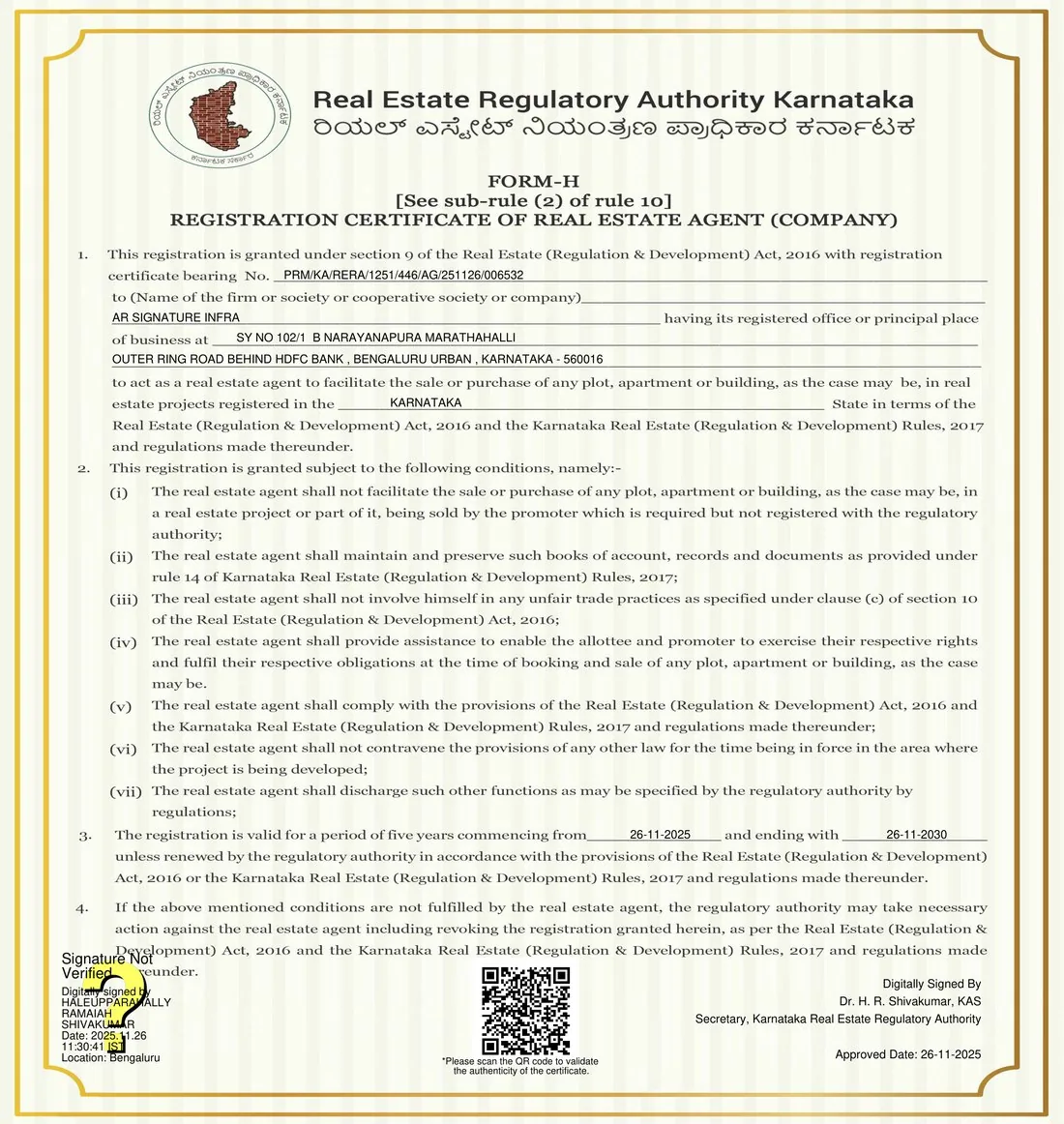
We are registered with Karnataka RERA as a real estate agent. The certificate was granted on 26 November 2025 and runs to 26 November 2030.
Put the number below into the agent search at rera.karnataka.gov.in. Then do the same with the registration number of any project we show you — it is on every project page, and we would rather you checked than took our word for it.
PRM/KA/RERA/1251/446/AG/251126/006532
Check us on the RERA portal ↗
What buyers ask us most — about working with us, and about buying a new flat in Bangalore. General answers, not legal advice: for your own purchase, a lawyer’s read is worth the fee.
Yes — that's most of the job. Every shortlist comes with the downside of each project written next to it: the long possession date, the joint development, the carpet area that's smaller than the brochure suggests, the stretch of road you'd drive twice a day. We'd rather lose the sale than have you find out after the booking amount.
Usually because it failed one of the checks above — litigation on the filing, a complaint on the RERA register, a possession date already passed, or nothing left to sell — or because it isn't one we market. Ask us about it anyway and we'll tell you why.
Occasionally, but it's not our core. We're strongest on new and under-construction projects from developers we already work with. If resale is what you want, we'll say so on the first call rather than waste your Saturday.
We'll stay on it with you through sanction, but the loan itself is between you and your bank. Ask early whether the project is on your bank's approved list: banks vet a project's land title and approvals once, and a loan on an approved project is usually sanctioned faster. If your bank hasn't approved it, it's worth knowing why.
Yes. NRIs and OCI cardholders can buy residential property in India, as long as the money comes through normal banking channels — an NRE or NRO account, or a remittance from abroad. The shortlist and the filing reads work over a call; for the site visit and the signing, someone you trust can stand in for you under a power of attorney.
Fine. Tell us the timeline and we'll keep it in mind rather than call you every Tuesday.
No. It's used to call you back and to introduce you to the developer of a project you've asked to see. It doesn't go on a list, into a bulk SMS tool, or to any other agency.
Yes, if it passes the same checks as everything else here. Here is how partnering with us works.
Look it up by its registration number at rera.karnataka.gov.in — every project page on this site gives the number. The filing shows the promoter, the land and how it is held, the sanctioned plan, the proposed completion date, and the quarterly progress reports filed as the build goes on. An apartment project of any real size has to be registered before it can be advertised or sold, so if one can't give you a number, stop there.
It means the promoter has put its plans, land title and completion date on the public record, and must keep 70% of the money buyers pay in a separate account used only for that project's land and construction. It doesn't mean the project will finish on time. That's why every project page shows the filed date next to the latest build progress — and why nothing with litigation or complaints on the register is listed here.
If possession runs past the date in your agreement for sale, RERA gives you the choice: stay in and be paid interest for every month of delay until you get the keys, or withdraw and get your money back with interest. Before you sign, check that the date in the agreement matches the one filed with RERA.
Carpet area: the usable floor inside the flat's outer walls, and the figure RERA requires your agreement to state. Super built-up adds the outer walls, balconies and a share of lobbies, lifts and the clubhouse — commonly a third or more on top of carpet for the same flat. Compare prices per carpet square foot; a cheap-looking rate on super built-up often isn't.
No more than 10% of the flat's cost. Under RERA a promoter can't accept more than that as an advance or application fee until you have signed and registered an agreement for sale. After that, payments follow the schedule in the agreement — usually in stages as construction progresses.
GST on an under-construction flat (none once the building has its occupancy certificate), stamp duty and registration, and usually a maintenance deposit or corpus fund, a covered car park where it's charged separately, and legal and khata-transfer charges. Some of these surface late — ask for all of them on one dated cost sheet before you pay the booking amount.
The RERA registration; the land's title deed and encumbrance certificate; the conversion order, if the land was farmland; the sanctioned building plan; the joint development agreement, if there is one; and the khata of the land. We go through these with you before any money moves — and a lawyer of your own is worth the fee.
Within Bengaluru's city limits, A-khata means a property is on the civic register as fully compliant, and it's what banks and future buyers expect. B-khata marks one with an irregularity, such as an unapproved layout or a building violation — loans and resale both get harder. A new flat gets its own khata only after completion, so before you book, check the khata and title of the land the project stands on. Outside city limits the records work differently again, which is one more reason to have a lawyer read them.
The planning authority issues it once a building is finished and matches its sanctioned plan. Permanent utility connections, the khata in your name and the last tranche of most home loans usually depend on it. Everything on this site is still under construction, so none has one yet — it's the document to insist on at handover, before you take the keys.
A landowner puts in the land, a developer builds, and the finished flats are split between them in an agreed ratio. It's common in Bangalore and not a red flag by itself. Ask to see the registered joint development agreement, and check whose share your flat falls in — the developer's or the landowner's — because that's who you're paying. Each project page shows what its filing says about how the land is held.
Under-construction usually costs less and lets you pay in stages, but you carry the risk of delay, and possibly rent in the meantime. Ready-to-move costs more, but you can inspect exactly what you're buying, and there's no GST once the occupancy certificate is issued. Everything on this site is under construction, which is why the filed possession date and the build progress sit near the top of every project page.
It's the promoter's own quarterly report to RERA, as we read it on the date shown — self-reported, so treat it as their claim and see the building for yourself on the visit. Its real use is against the possession date: 20% built with a year to go doesn't add up.
Leave a number and we call back the same day. No bots, no drip campaign.
Leave your number →